Buyer guide
The pH of bacteriostatic water — and why it isn’t 7
Buyers test a vial with a pH strip, read 5.5, and wonder if the lot is bad. It isn’t — 5–6 is the correct, honest result for an unbuffered diluent. Here is the chemistry, and why we don’t “fix” it.
Quick answer
- —Typical reading: pH 5–6. The USP pharmacopeial range is 4.5–7.0; Hospira’s own product ships near 5.7.
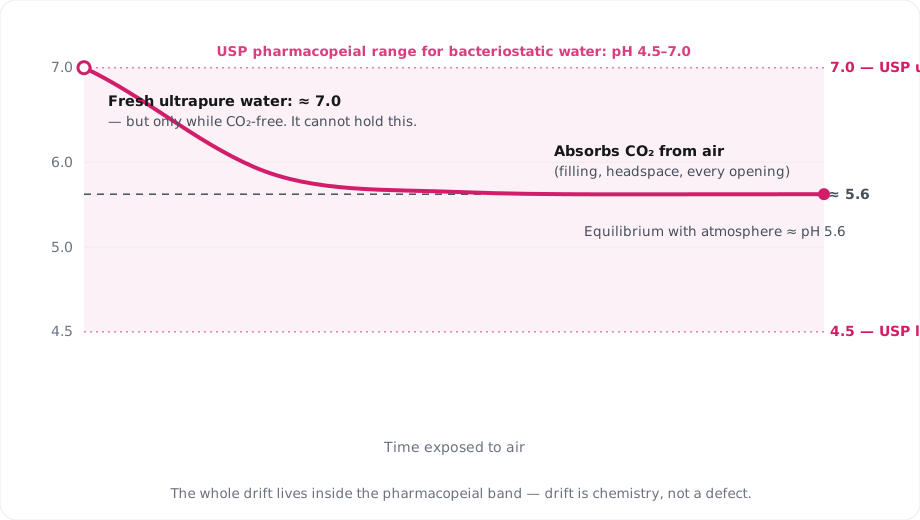
- —It drifts on purpose-free chemistry: pure water absorbs CO₂ from air and settles ≈ 5.6. It cannot hold 7.0 by itself.
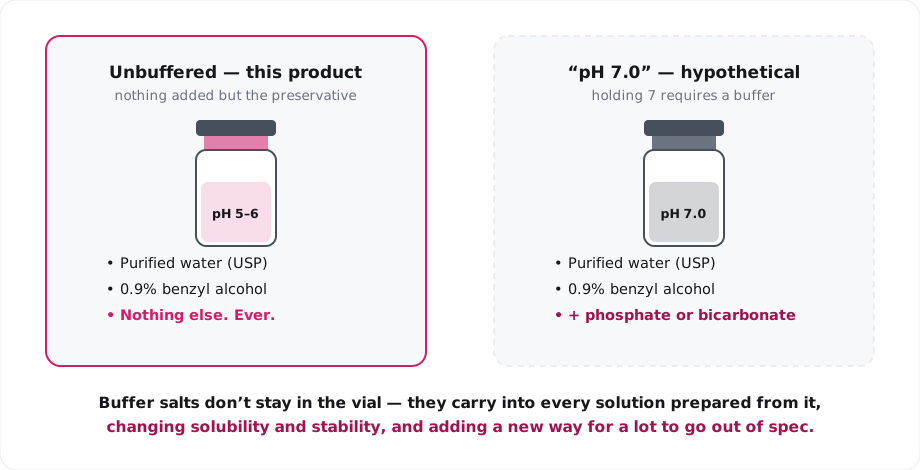
- —We don’t buffer it. Unbuffered means nothing in the vial but purified water and 0.9% benzyl alcohol.
Pure water can’t hold pH 7 by itself
Getting water to a reading of exactly 7.0 means adding something to it — and once you add something, it is no longer just water. Left alone, very pure water exposed to air absorbs carbon dioxide, which forms carbonic acid. Within hours the reading slides from 7.0 toward an equilibrium of about pH 5.6. It happens during filling, from the air sealed in the vial headspace, and at every opening after.
Holding 7.0 would make the product worse
The only way to hold a reading of 7.0 is a buffer — phosphate or bicarbonate salts. That single change cascades: the vial is no longer standard bacteriostatic water (purified water plus 0.9% benzyl alcohol); every solute prepared from the vial gets the buffer salts too, where they can shift solubility or stability; many compounds are more stable slightly acidic; and the lot gains a higher conductivity and a brand-new way to fail specification. A buffer is another ingredient to source, assay, and stand behind — for no benefit.
The acidity doesn’t matter in the vial
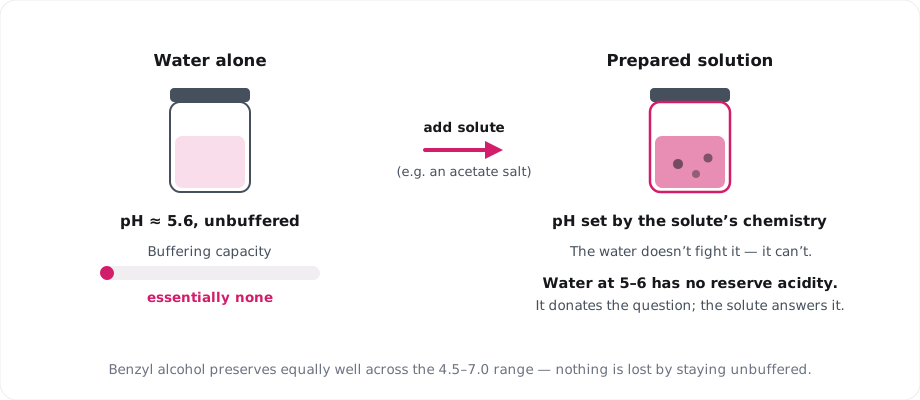
Water at 5.6 sounds acidic until you look at buffering capacity, which is essentially zero. There is no reserve of acid to push a dissolved solute anywhere. Most compounds prepared in this diluent are supplied as salts — acetates and the like — and the solute’s own chemistry sets the pH of the prepared solution, not the water. The water donates the question; the solute answers it.
What the spec actually says
The pharmacopeial monograph for bacteriostatic water sets pH between4.5 and 7.0 — a band that exists precisely because unbuffered water is expected to sit on the acidic side of neutral. Reference manufacturers ship in the middle of it (Hospira’s product is commonly measured near 5.7). Every Bac Water Co. lot is released with a Certificate of Analysis reporting its measured pH, alongside sterility (USP <71>), endotoxin, and benzyl alcohol concentration — so the number on your strip can be checked against the lot, not a myth.
| Measurement | Value |
|---|---|
| USP pharmacopeial range | pH 4.5 – 7.0 |
| Typical unbuffered reading | pH 5 – 6 |
| Air-equilibrated pure water | ≈ pH 5.6 |
| Reference commercial product | ≈ pH 5.7 (Hospira) |
pH questions, answered
Is bacteriostatic water supposed to be pH 7?+
No. Pure water cannot hold pH 7 by itself — it absorbs carbon dioxide from the air and settles around pH 5.6. The USP pharmacopeial range for bacteriostatic water is pH 4.5–7.0, and unbuffered water typically reads 5–6. That is the correct, in-spec result, not a defect.
Why not buffer the water to hold pH 7.0?+
Holding 7.0 requires adding phosphate or bicarbonate buffer salts. Those salts would then be present in every solution prepared from the vial, where they can affect solubility and stability. They also raise conductivity and add a new way for a production lot to fall out of specification. An unbuffered diluent avoids all of that.
Does pH 5–6 affect what I dissolve in it?+
Practically no. Water at pH 5.6 has essentially no buffering capacity, so it does not push a dissolved solute toward acidity. Once a solute is added, the solute’s own chemistry — most are supplied as salts — sets the pH of the prepared solution.
What pH do reference manufacturers ship at?+
Commercial bacteriostatic water for injection typically ships near pH 5.7 — squarely inside the same 4.5–7.0 pharmacopeial band. Every Bac Water Co. lot ships with a Certificate of Analysis reporting its measured pH, alongside sterility, endotoxin, and benzyl alcohol results.
Unbuffered, and documented on every lot
USP-grade 10 mL and 30 mL vials — purified water and 0.9% benzyl alcohol, nothing else — with a Certificate of Analysis for every production lot. For research and laboratory use.